
Cybersecurity hiring depends heavily on demonstrable technical ability, yet candidates usually have to pass an initial screening before anyone evaluates those skills closely. The U.S. Bureau of Labor Statistics projects employment for information security analysts to grow 29 percent from 2024 to 2034, much faster than the average for all occupations. Demand creates opportunities for qualified professionals, but applicants still need to communicate their capabilities clearly enough to reach the technical stages of hiring.
This creates an interesting question for ethical hackers, security analysts, penetration testers, and other technical candidates: does resume tailoring software have a meaningful place in a profession where certifications and practical ability carry considerable weight? Two reasonable positions emerge. One says technical credentials should largely speak for themselves. The other recognizes that even highly skilled applicants may first encounter digital screening systems and recruiters who need to identify relevant qualifications quickly.
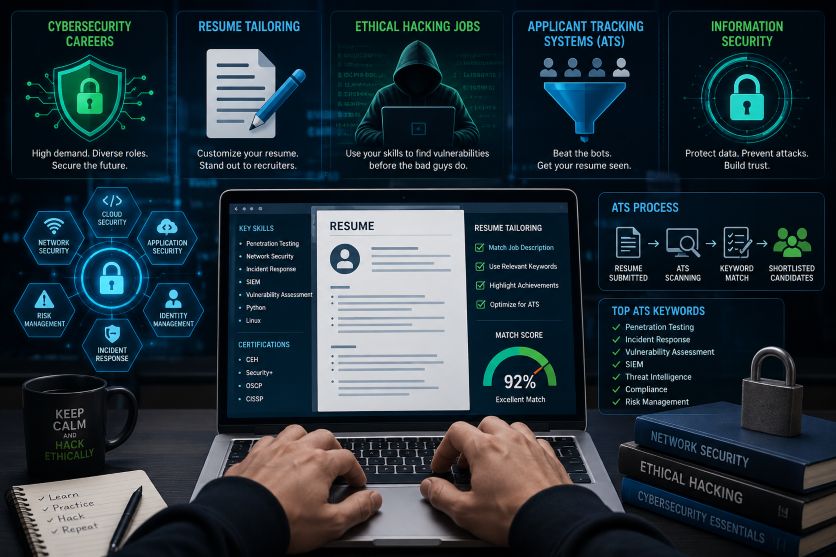
Cybersecurity is a field where employers can test what applicants actually know. Technical interviews, practical exercises, portfolio projects, labs, and discussions about previous responsibilities can reveal whether someone understands the technologies listed on a resume.
Professional credentials provide another recognizable signal. CompTIA positions certifications such as Security+ around foundational security skills, while ISC2 maintains certifications covering areas such as security operations, architecture, engineering, and risk management.
For that reason, there are several arguments for keeping resume optimization in perspective:
From this viewpoint, tailoring should remain secondary. A polished application might help present qualifications, but it cannot create the underlying expertise that security employers ultimately need.
The competing view starts earlier in the hiring process. Before a cybersecurity specialist evaluates an applicant’s knowledge, the resume may need to move through an applicant tracking system and an initial recruiter review. Society for Human Resource Management resources on recruiting technology describe how digital platforms have become part of modern talent acquisition and candidate management.
Cybersecurity terminology makes this stage particularly important. Closely related responsibilities can be described using different terms, abbreviations, platforms, and frameworks. A candidate may have relevant experience without presenting it in language that closely reflects the vacancy.
The National Institute of Standards and Technology illustrates the breadth of the profession through its NICE Workforce Framework, which provides common language for cybersecurity work, including tasks, knowledge, and skills. Security operations, penetration testing, governance, cloud security, identity management, and vulnerability management may overlap, but employers can prioritize very different competencies for each position.
The strongest argument for using an automated tailoring tool is therefore organization rather than qualification. It can help applicants identify what deserves attention while leaving decisions about accuracy to the person who actually performed the work.
None of these changes requires inventing experience. The purpose is to make legitimate qualifications easier to identify and understand.
The limitations are just as important as the benefits. Cybersecurity applicants work in a profession where technical claims can be examined closely, so automated suggestions require careful human review.
The NIST NICE framework’s distinction among work activities, knowledge, and skills is useful here. Knowing about a technology is different from applying it professionally. Cybersecurity applicants benefit from making those distinctions clear rather than allowing automated recommendations to blur them.
The two sides of the argument do not have to cancel each other out. Cybersecurity applicants need genuine technical ability, but they also need a resume that communicates that ability effectively during the early stages of recruitment.
A sensible approach starts with a detailed master resume containing accurate experience, certifications, projects, tools, and technical skills. Candidates can then compare that information with individual vacancies and decide what deserves greater emphasis. It is also worth considering their professional digital presence, since public profiles and other information available online can shape how their background is presented beyond the resume itself.
The final test is straightforward. Every certification, platform, framework, programming language, and security responsibility included in the document should be something the applicant can explain confidently if an interviewer asks about it.
Automated tailoring therefore fits best as an editing aid rather than a qualification generator. As cybersecurity roles become increasingly specialized, adjusting a resume for a specific position can help relevant experience stand out. The substance, however, must still come from the applicant. For security professionals, a strong application is ultimately one that balances discoverability with technical credibility.